What Is an Agentic Sales Platform? A Complete Guide (2026)
Auron Team

Auron is an Agentic Sales Platform - AI agents that combine enterprise data with seller judgment to understand every customer and opportunity, and act, engage, and execute sales work on a rep's behalf. It's built for revenue teams who want more sales capacity without adding headcount at the same rate.
What is an agentic sales platform?
An agentic sales platform is AI software that combines sales data, business context, and seller input to understand opportunities and execute approved sales tasks. Unlike traditional sales automation, which follows predefined rules, an agentic platform can evaluate context, choose the right next action, and involve a human when judgment or approval is needed.
Sales teams already have more information than they can act on easily. CRM records, emails, meeting transcripts, engagement signals, dashboards, and AI-generated summaries can tell teams what happened. The harder problem is determining what should happen next.
That is the gap agentic sales platforms are designed to address.
Auron is an agentic sales platform built for exactly this: a sales partner for the rep that combines enterprise data with seller judgment, then gives AI agents the context to act on it.
Why are agentic sales platforms emerging now?
What remains difficult is turning all of that information into the right action - and much of what matters most never makes it into a system at all.
A sales rep may recognize that a champion is losing influence before there is an obvious CRM signal. They may sense that a buyer is hesitant even though the meeting transcript contains no clear indication of resistance. They may know that a deal needs executive involvement rather than another follow-up email.
That judgment is valuable, but it often remains outside the systems used to manage revenue. At the same time, AI has become capable of handling more sales work, including research, summarization, content creation, follow-up, prioritization, and workflow execution.
Gartner predicts that 40% of enterprise applications will feature task-specific AI agents by the end of 2026, up from less than 5% in 2025.
For sales specifically, Gartner predicts that AI agents will outnumber sellers by 10 to 1 by 2028, while fewer than 40% of sellers are expected to say AI agents improved productivity.
These predictions point to an important distinction: adding more AI agents does not automatically create more sales productivity.
The real opportunity is to connect agents to the right data, workflows, seller judgment, and governance so they can perform useful work within defined boundaries.
How does an agentic sales platform work?
An agentic sales platform works by combining seller judgment with enterprise data to build a continuously updated understanding of an opportunity, then giving AI agents the authority to act on that understanding directly.
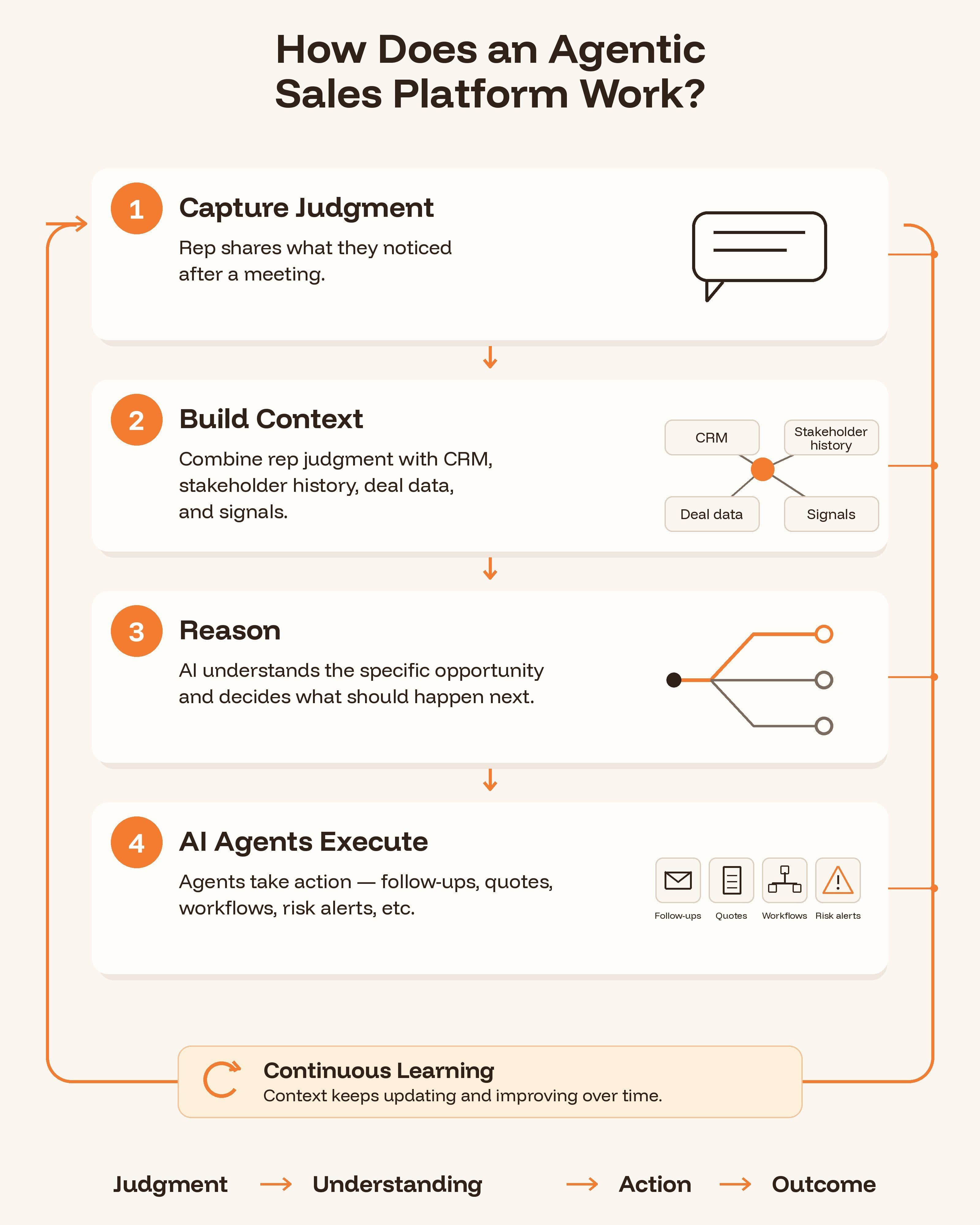
The mechanism follows a consistent logic: Judgment becomes understanding, understanding becomes action, action becomes outcome. In practice, that plays out in four steps:
1. Capture judgment
Traditional sales systems are good at recording what happened. An agentic sales platform can also capture what the seller concluded. After a customer interaction, the platform can ask questions such as:
- What stood out to you?
- What concerned you?
- How do you think the buyer feels about the opportunity?
- What do you think needs to happen next?
The goal is not to create another administrative task. It is to capture the seller's perspective while the interaction is still fresh.
2. Build context
That judgment gets connected to the account: stakeholder history, prior interactions, signals, deal stage. A comment like "I think the CFO isn't bought in" becomes far more useful once it's linked to who the CFO is, what they've said in past meetings, and how their engagement has trended.
3. Reason
The platform weighs that combined picture the way an experienced rep would, rather than applying a fixed rule. It's reasoning about this specific opportunity, with the rep's own judgment as a primary input, not pattern-matching against every deal in a database.
4. Agents execute
The platform acts: drafting a follow-up, flagging a risk, preparing a quote, triggering a workflow, or escalating a decision that needs a human. Execution happens inside defined permissions - the platform isn't acting on authority it wasn't given.
A fifth element runs underneath all four: continuous learning. Understanding doesn't reset after each interaction - it compounds. A judgment captured this week informs how the platform reads a signal next week, which is also what keeps an account moving in the days between conversations, instead of going quiet until the rep's next scheduled touchpoint.
This is the structural difference from traditional Sales AI, which stops one step earlier at every stage:
- Captures conversations → captures human judgment
- Analyzes information → builds sales context
- Recommends actions → reasons about what should happen next
- A human executes → agents execute within defined permissions
What Does an Agentic Sales Platform Do for Sales Reps?
For a sales rep, the technology is easier to understand as a sales partner than as another software category. The experience can be viewed across four stages.
Prepare
Before a customer interaction, the platform brings together relevant account and stakeholder context so the rep can prepare without searching across multiple systems.
Engage
During the interaction, the rep stays focused on the customer while the platform keeps what matters to this specific buyer close at hand - for example, the pricing concern the CFO raised last meeting, or the stakeholder who has gone quiet since the last call.
Act
After the interaction, the platform captures the rep's judgment and can turn that understanding into practical next steps, such as preparing follow-up or identifying an opportunity risk.
Continue
Between interactions, the platform can monitor the account and execute approved actions so opportunities do not depend entirely on the rep remembering every follow-up.
Outcome
Across every stage, the result is the same: greater customer engagement, broader account and opportunity coverage, and better conversion for the rep who owns the relationship.
Throughout, the rep remains responsible for the relationship and the decisions that require human judgment.
The platform's role is to reduce the amount of sales work that depends on manual tracking, memory, and administrative effort.
Agentic Sales Platform vs. Sales Automation vs. AI Sales Assistant
A quick way to see the difference in practice: imagine a deal has gone quiet for a week. Sales automation fires a pre-written follow-up email on day 7, regardless of context, because that's the rule.
An AI sales assistant notices the gap, flags it in a dashboard, and suggests a follow-up - but a rep still has to see the flag, decide it's worth acting on, and send something.
An agentic sales platform connects the gap to what it already knows about the deal - including a judgment the rep logged two weeks ago that the champion seemed hesitant - reasons that this specific silence is worth escalating rather than nudging, and either drafts a tailored follow-up or surfaces the risk as something that needs a decision, not just a task.
Zoom out, and these are not competing categories - they are steps on the same progression:
Sales AI - Revenue Orchestration - AI Sales Agents - Agentic Sales - Autonomous Sales Execution.
Each step hands more of the work to the system. At the agentic stage, the platform doesn't just do more - it decides with more context.
How is an agentic sales platform different from Gong, Salesloft, and Agentforce?
The honest answer: less in whether the AI acts, and more in where its judgment comes from. All three of the platforms below now describe themselves as closing the gap between insight and execution - autonomous action alone is no longer a differentiator in this category.
Gong positions itself as a Revenue AI Operating System: a Revenue Graph that connects customer interactions and revenue data across the business, a team of specialized AI agents, and applications (Engage, Forecast, Enable) that put agents and reps to work on top of it. Gong describes this as "governed agentic execution" - humans and agents working together inside one system.
Salesloft - formerly Clari + Salesloft, which merged in December 2025 and moved forward under a single Salesloft brand in September 2026 - positions itself as the Predictive Revenue System. It runs on a Revenue Engine that captures and analyzes interactions across the revenue stack, with AI agents and Rhythm prioritizing work across create, convert, close, and retain.
Salesforce Agentforce Sales positions itself around agents that prospect, qualify leads, and keep pipeline moving directly inside the Salesforce ecosystem - grounded in Data 360 and customer data across sales, service, marketing, and commerce, with the Atlas Reasoning Engine deciding what to do next.
All three build their agents' intelligence from data the system already has access to: recorded conversations, CRM activity, or unified customer profiles. That's real and valuable - but it's still inference. None of them are built to ask the person who was in the room what they actually concluded.
That is where Auron is different. Auron doesn't infer judgment from a transcript. It asks for it. After every meaningful interaction, it debriefs the rep - capturing the read on a deal that never got said out loud - and gives its agents that judgment as a direct input. As autonomous execution becomes table stakes, where the intelligence comes from is what separates one platform from another.
Who is an agentic sales platform for?
Agentic sales platforms are typically bought by CROs, VPs of Sales, and RevOps leaders evaluating how to scale sales capacity without a proportional rise in headcount, and used day-to-day by the sales rep, whose relationship and judgment the platform is built around.
The buyer's question is usually about scalability: how much more coverage, engagement, and conversion can the organization get from its existing team. The rep's experience of the same platform is closer to a partner that debriefs with them after every meeting, keeps the account moving between conversations, and hands back time that used to go into admin and note-taking.
Why does an agentic sales platform matter?
Enterprise sales doesn't have an information problem - it has an execution gap. Even when a rep understands exactly what a deal needs, nearly all of the resulting work still runs through them: decide, create the task, follow up, update the system, and repeat across every opportunity they own. Human sales capacity can't scale with the amount of sales work required, and headcount is the only lever most systems leave.
An agentic sales platform is built to close that gap: capture the judgment that already exists in a sales team, connect it to context, and let agents handle the resulting execution - so a team's output can scale without a 1:1 increase in headcount.
For a revenue leader, that is the promise behind platforms like Auron: 10x your sales team. For the individual rep, it shows up as 10x the customer engagement, coverage, and conversion - as a partner, not a replacement.
For a revenue leader evaluating this category, that promise shows up in a few concrete places:
Coverage - more accounts and opportunities actively managed per rep, because follow-up and monitoring no longer depend entirely on the rep remembering to do it.
Engagement - shorter follow-up latency and more signals actually acted on, since the platform is watching accounts continuously, not just during scheduled touchpoints.
Conversion - fewer opportunities stall for lack of a timely next step, because the system already knows what "timely" means for that specific deal.
None of this replaces the judgment a good rep brings - it's the opposite. The whole mechanism depends on that judgment being captured well in the first place. What changes is how much of the resulting work has to run through the rep's own time and memory to happen.
See an agentic sales platform in action
Auron is the agentic sales platform that turns your reps' judgment into action. See how the Auron platform works, or keep reading: why AI sales agents miss what your reps know and what agentic customer engagement looks like in B2B.
Frequently asked questions
What is an agentic sales platform?
An agentic sales platform is AI software that combines enterprise data with seller judgment to autonomously understand and act on sales opportunities - deciding next steps and executing them, rather than only recommending actions for a human to carry out.
Is an agentic sales platform the same as an AI sales agent?
Related but not identical. An AI sales agent is the individual unit that acts - drafting a follow-up, updating a record. An agentic sales platform is the broader system: the judgment capture, context, and reasoning that decides what those agents should do.
Does an agentic sales platform replace sales reps?
No. The rep still owns the relationship and the important decisions. An agentic sales platform is built to be a partner that captures the rep's judgment and handles more of the resulting execution, not a substitute for the rep.
How is an agentic sales platform different from sales automation?
Sales automation follows fixed if-this-then-that rules regardless of context. An agentic sales platform reasons about context - including judgment a rep provides directly - and decides what to do next before acting.
How is an agentic sales platform different from Gong, Salesloft, or Agentforce?
Those platforms build agents on signal inferred from recorded conversations, CRM activity, or unified customer data. An agentic sales platform like Auron also elicits judgment directly from the rep - the read on a deal that never got said out loud - and uses that as an input agents can act on.
Who buys and uses an agentic sales platform?
CROs, VPs of Sales, and RevOps leaders typically evaluate and buy agentic sales platforms to scale sales capacity without proportional headcount growth. Sales reps are the primary day-to-day users, working alongside the platform as a partner.