Why AI Sales Agents Miss What Your Reps Know
Team Auron
Signal-inferred revenue orchestration routes AI actions off recorded call and CRM data. But it can't capture what reps actually concluded.
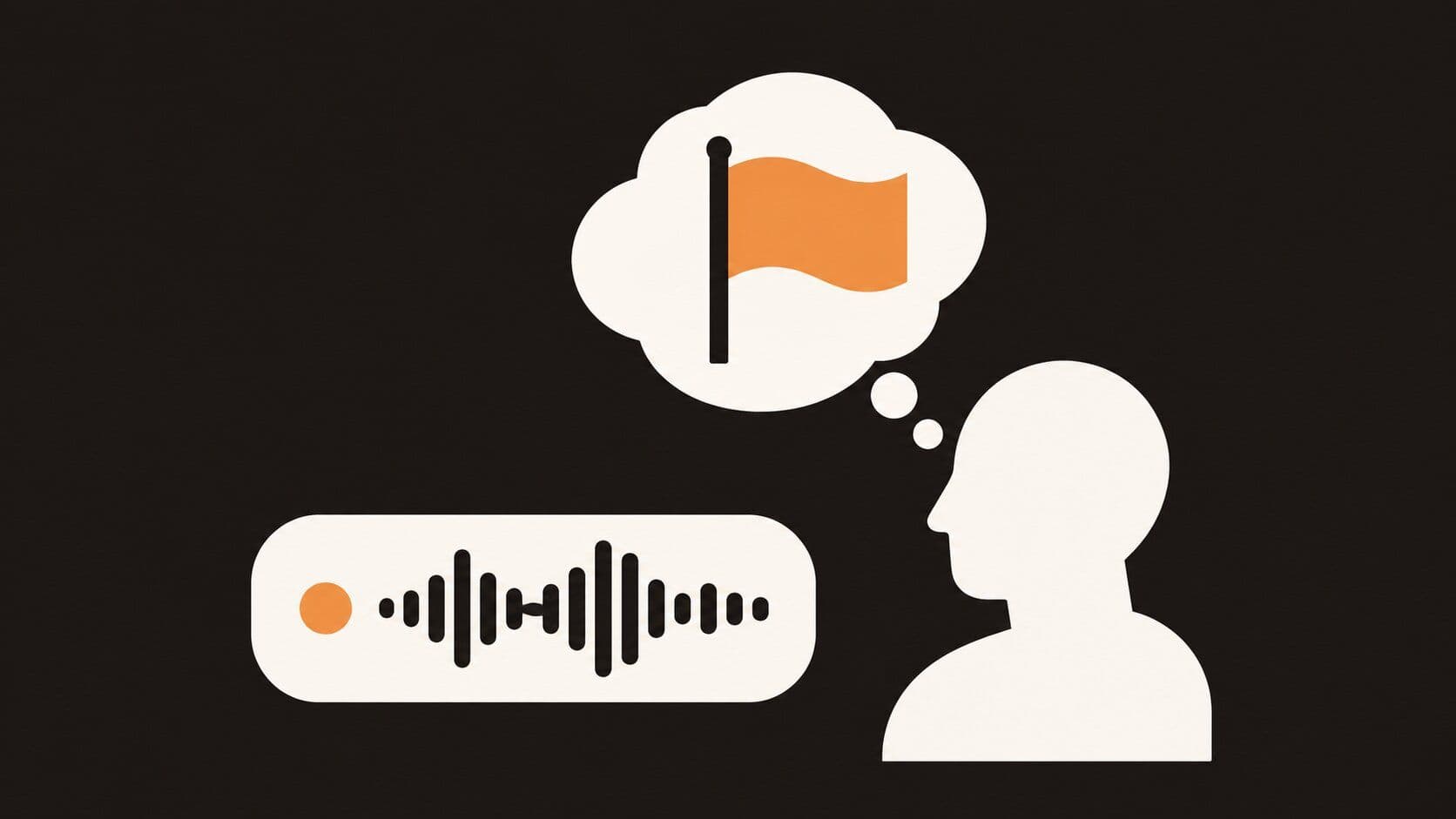
A rep walks out of a customer meeting with a nagging feeling: the CFO nodded along but never really bought in. Nothing in the transcript says so. No intent score drops. The CRM still shows the deal on track. The most important piece of intelligence in that deal exists in exactly one place, the rep's head.
That's the blind spot in signal-inferred revenue orchestration, the approach most revenue teams now use to route AI sales agents off recorded data: call transcripts, CRM activity, intent data, engagement patterns. It's a real upgrade over static CRM records. But it works a bit like a fitness tracker. It can count every step you took this week. It can't tell you that you skipped the gym because your knee hurts. A transcript can tell you what was said. It can't tell you what the rep concluded from it.
This is the gap Auron is built around. Auron is an Agentic Sales Platform and a sales partner for the sales rep. It combines enterprise data with seller judgment to understand every customer and opportunity, and gives AI agents the intelligence to engage, act, and execute sales work on the rep's behalf. Where most AI for sales today infers intelligence from what was recorded, Auron asks for it directly.
What is signal-inferred revenue orchestration?
Signal-inferred revenue orchestration is a system that captures buyer and account signals from recorded data, such as calls, emails, and CRM activity, and routes AI-driven next actions off those signals.
The category has moved through two broad stages.
The first was about capture: call notes, transcription, conversation intelligence, the shift from nothing being recorded to nearly everything being recorded.
The second, where most of the market sits today, is about execution: agents and automated workflows layered on that same recorded data, recommending and increasingly taking the next action without a rep having to ask. Intent data, technographic changes, sentiment shifts, and objection tracking all feed the same loop: something happens, a system infers what it means, an agent acts on the inference.
What are the limitations of revenue orchestration built only on inferred signals?
Inferred signals describe behavior. They're not built to capture the reasoning behind it, and a system that only reads recordings has no reliable way to know what a rep actually concluded from a conversation.
A few places this shows up in practice:
Transcripts show what was said, not what it meant. A quiet CFO on a call could signal disengagement, or it could mean the CFO is already sold and letting the champion run the meeting. Only the rep in the room has a read on which one it was.
The most important read on a deal is often never said out loud. A hunch that a champion has lost influence, a sense that internal politics have shifted, a doubt the rep didn't voice in the meeting itself: none of it exists in a recording, because it never became audio.
That judgment tends to stay with the rep. Without a structured way to capture it, an account's most useful context leaves the organization when the rep who built the relationship does.
These systems know what happened. They generally don't know what it meant, and closing that gap requires a second, human-sourced layer of intelligence rather than a faster version of the first one.
Rep knowledge vs. AI signals: what's the actual difference?
Rep knowledge is the judgment a salesperson forms through direct experience with a buyer. AI signals are patterns a system infers from recorded interaction data. They answer different questions, not the same question in different formats.
Both layers matter. Inferred signals are good at telling a team what happened across hundreds of accounts at once, more than any rep could track manually. Rep knowledge is good at explaining why it happened on the one account that matters most right now. A revenue orchestration system built on only the first layer is working with half the available intelligence, usually the harder half to act on.
Why do AI sales agents built only on recorded signals hit a ceiling?
Because autonomous execution on inferred signals alone is no longer a durable advantage. When every system reads the same kinds of transcripts and scores the same intent data, the recommendations start to look alike, and execution becomes table stakes. What still sets a platform apart is where its intelligence comes from in the first place.
Most revenue AI platforms today derive their intelligence from recorded interactions and system-generated signals: call recordings, CRM activity, email engagement, intent data. Many of these platforms are strong at turning that data into recommended, and increasingly automated, next steps. That's not a knock on execution quality. It's a description of where the category's intelligence tends to come from.
A broader tier of signal-based tools sits one step further out again, drawing almost entirely on signals outside the conversation itself: website visits, technographic changes, firmographic fit, intent data. Useful for prioritizing which accounts to work. Still not built to reach the judgment a rep formed inside a specific meeting.
Across the category, the pattern holds. Sales AI has gotten steadily better at capturing, from notes to transcripts to conversation intelligence, and more recently at executing, from recommendations to agent-run workflows. It has made far less progress asking the person who was actually in the room what they think a signal means. That's the question the next generation of AI sales agents has to answer.
What does this gap actually cost a revenue team?
It shows up in numbers RevOps already tracks, just not attributed to its real cause. Forecast slippage is one example: a deal can look healthy on every recorded metric, engagement frequency, response time, stage progression, right up until it stalls, because the thing that actually put it at risk was a read the rep had weeks earlier with no structured way to surface it. By the time it appears in the pipeline data, it's a save-the-deal conversation instead of a manage-the-risk one.
Account handoffs are the second place it shows up. When a rep leaves, the transition usually consists of whatever is in the CRM: activity logs, email threads, maybe a recording or two. The rep's actual read on the account, who really has influence, what's already been tried and didn't work, which stakeholder needs careful handling, tends to leave with them, because it was never captured anywhere retrievable. The next rep starts closer to zero than the account's history should allow.
There's a third cost, and it's the one that caps growth. Even when a rep does understand what's happening in a deal, nearly all the work that follows still lands on that same person: decide the next step, draft the follow-up, update the CRM, then repeat across every opportunity they own. Sales capacity can only grow as fast as headcount, because the work never leaves the rep's desk.
None of these is really a data problem. The underlying information existed. What was missing was a mechanism built to ask for the part of it that only exists in a person's head, and agents that could act on what it revealed.
What is an Agentic Sales Platform?
An Agentic Sales Platform is an AI for sales system that combines enterprise data with seller judgment, elicited directly from the rep, and gives AI agents the intelligence to prepare, engage, act, and execute sales work on the rep's behalf. It differs from earlier categories like conversation intelligence or sales engagement software by pairing AI agents with a richer intelligence layer than recorded data alone provides.
How Auron closes the gap between signals and rep knowledge
Closing this gap means treating rep judgment as a first-class signal rather than a coaching artifact buried in a call recording nobody revisits. That means a mechanism that asks for it, connects it to account context, and turns the resulting understanding into action before the rep's read on the deal fades.
This is the logic Auron is built around: judgment becomes understanding, understanding becomes action, action becomes outcome. In practice, it plays out across four stages of a rep's relationship with an account.
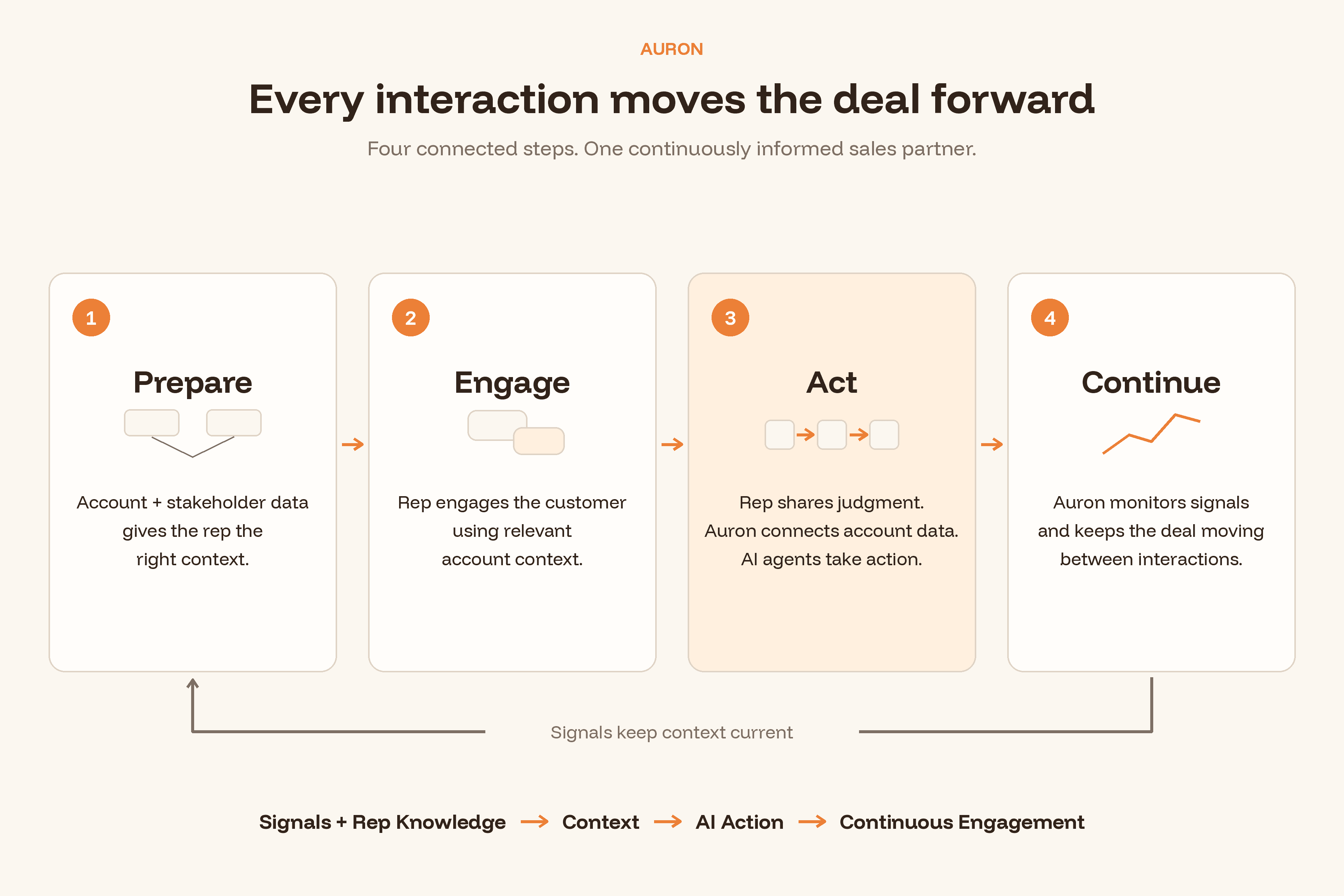
Prepare. Before a customer interaction, Auron gathers relevant account and stakeholder context, so the rep starts the conversation already informed, rather than reconstructing history from memory.
Engage. During the interaction, Auron helps the rep stay grounded in what matters to this specific customer, like the open question from the last call or the stakeholder who has gone quiet, rather than a generic script built for the average deal.
Act. This is where the gap actually closes. Right after the interaction, while the rep's read is freshest, Auron asks how the meeting went, what concerned the rep, why they think that happened, and what should happen next. That answer, whether it's a hunch, a doubt, or a read on a stakeholder, becomes organizational intelligence connected to the broader account, rather than staying in one person's head. An agent then turns that understanding into action: flagging the risk, preparing the follow-up, updating the CRM, escalating whatever needs a human decision.
Continue. Between interactions, when a deal is most likely to quietly stall, Auron keeps monitoring signals and acting on the rep's behalf, so the relationship keeps moving even while the rep's attention is elsewhere.
Over time, the understanding compounds. Every new interaction and every rep debrief adds to the account's context, so Auron's agents work from an evolving picture of the deal instead of resetting after each meeting.
The result is the outcome Auron is built to deliver: 10x the sales rep's customer engagement, coverage, and conversion. More accounts actively covered, more relationships kept moving between meetings, and more of the follow-up executed by agents instead of waiting on the rep's calendar.
Throughout, the rep still owns the relationship and the decisions that matter. Auron doesn't replace the salesperson. It's a sales partner that works alongside them and preserves the intelligence that would otherwise stay locked in the rep's head.
The next layer of revenue orchestration
Signal-inferred revenue orchestration moved sales teams from static records to recorded intelligence, and more recently from recommendations to autonomous execution. That's real progress. But it has a structural ceiling: it can act on what happened, not on what a rep concluded from being there.
The next generation of sales AI won't win by inferring more signals or executing more actions on its own. It will come from combining machine-derived signals with the judgment of the people closest to the customer.
That's the layer Auron is built around: not just capturing information, but capturing understanding, and giving AI agents what they need to act on it alongside the rep who owns the relationship.
Frequently asked questions
What is the difference between revenue orchestration and an Agentic Sales Platform?
Revenue orchestration typically routes AI-driven actions off signals inferred from recorded data. An Agentic Sales Platform like Auron combines enterprise data with judgment elicited directly from the rep, then gives AI agents the intelligence to execute sales work on the rep's behalf.
Can AI infer what a sales rep is thinking during a deal?
Not reliably. AI can infer patterns from what was recorded, tone, word choice, engagement frequency, but a rep's unstated doubts and interpretations generally only surface when something actively asks for them.
What signals do revenue orchestration platforms typically miss?
They tend to miss judgment that was never said out loud: a hunch that a champion has lost influence, a sense that internal politics have shifted, or a doubt the rep didn't voice in the meeting itself.
Is human judgment still necessary now that AI agents can execute sales work autonomously?
Yes. Execution quality depends on the intelligence behind it. Agents acting only on inferred signals tend to converge on similar recommendations; agents acting on elicited rep judgment have a more differentiated, deal-specific basis for the actions they take.
How quickly does a rep's read on a deal fade after a customer meeting?
A rep's interpretation is often freshest immediately after a customer meeting, which is why timely capture matters. The longer it waits, the more likely it is to blur with the next call or get lost entirely.