What If Your CRM Knew What Your RMs Know?
Auron Team

FRIP by Auron brings Farm Relationship Intelligence into the everyday work of Farm Credit relationship managers. By capturing field knowledge, connecting borrower context, and turning relevant intelligence into follow-ups and next actions, FRIP helps relationship managers carry more context from one conversation to the next while complementing the CRM as the system of record.
A borrower record shows what the operation looks like today. The relationship manager knows what the family is thinking about next.
That difference is where Farm Relationship Intelligence begins.
Imagine a Farm Credit relationship manager, or RM, leaving a corn-and-soybean operation after a field visit. The family may lease additional acreage before the next operating-line renewal. An equipment purchase is becoming more concrete. And a commitment from an earlier conversation still needs follow-through.
The formal borrower record remains essential. But it does not automatically capture what the relationship manager understood from the visit: what changed, what became more serious, and what deserves attention next.
FRIP, or Farm Relationship Intelligence Platform, by Auron captures that field knowledge, connects it with the borrower relationship, and turns relevant intelligence into follow-through.
What Is Farm Relationship Intelligence?
Farm Relationship Intelligence is the context, judgment, and relationship knowledge created through borrower interactions that structured account data does not fully capture.
It is the difference between knowing the size of an operation and knowing that additional leased acreage may affect the conversation before renewal. It is knowing not only that equipment financing has been discussed, but that the discussion has moved from exploratory to actionable.
FRIP is designed to capture that second layer.
For Farm Credit AI, this distinction matters. The goal is not to ask AI to create relationship judgments on its own. The relationship manager interprets what mattered; FRIP makes that intelligence structured, connected, and usable.
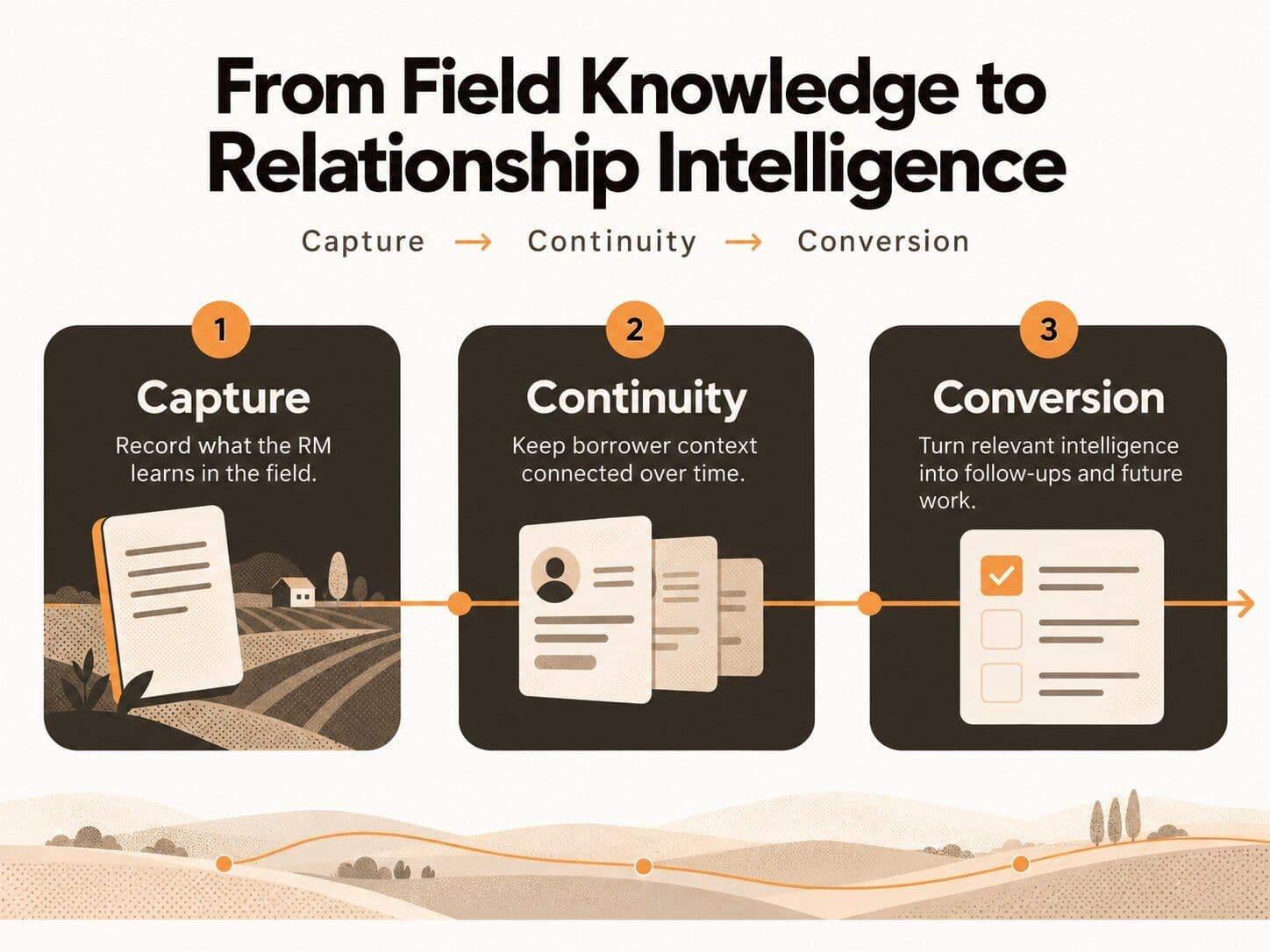
The mechanism follows three movements:
Capture → Continuity → Conversion
Capture turns field knowledge into structured intelligence. Continuity keeps that intelligence connected to the borrower as the relationship develops. Conversion moves relevant intelligence into follow-ups, handoffs, preparation, and other next steps.
Auron’s Farm Lending product describes the same three movements: voice-first field capture, a living borrower picture, and field intelligence converted into completed work.
Capture: How Does FRIP Turn a Farm Visit into Intelligence?
FRIP doesn’t guess what mattered from a transcript. It asks the person who was in the room.
After a farm visit, the relationship manager can capture a short voice debrief while the interaction is still fresh. The value is not simply converting speech into text. It is capturing the RM’s interpretation of the conversation.
A borrower may mention additional acreage casually. The relationship manager understands why its timing matters before renewal.
Equipment may come up again. The RM recognizes that the conversation is becoming more concrete.
A family member may participate differently this time. The RM understands that the decision dynamic may be changing.
That human interpretation is what separates Farm Relationship Intelligence from a note-taking tool.
Auron also supports a Discovery mode in which an agent can actively ask follow-up questions to draw out additional detail. Like a good manager, it probes for the details an RM might not think to mention. Teams can configure when Discovery mode is used.
See how Auron’s voice-agent modes work
Continuity: How Does Each Conversation Build on the Last?
Continuity means the next borrower interaction can begin from accumulated intelligence rather than reconstructing the background each time.
Once the debrief is captured, the resulting intelligence does not have to remain in an isolated voice note. It can be associated with the relevant borrower's record so that subsequent interactions have access to what the institution has already learned.
The leased-acreage conversation gains meaning when connected with renewal timing. The developing equipment plan has the history of earlier discussions around it. An open commitment remains associated with the borrower instead of depending on someone remembering it later.
Auron’s record model is built around this idea: sessions are linked to records, and accumulated knowledge can build around the entity being discussed.
The broader enterprise-AI principle is similar. Gartner’s 2026 research recommends developing reusable context into a first-class enterprise asset rather than rebuilding it separately for every AI agent.
That is what connection adds to the FRIP workflow. A field observation stops being an isolated moment and becomes part of the borrower’s continuing context.
Suppose the same RM speaks with the operation several weeks later.
The acreage conversation already has history. The equipment plan has progressed from an earlier stage. The status of the previous commitment is available. Instead of rebuilding the story, the relationship manager can focus on what has changed.
That is the role continuity plays here.
It is not primarily about an RM leaving or a territory changing. That deserves its own discussion. Here, continuity means one interaction making the next interaction more informed.
Over time, the borrower's picture becomes more useful because new intelligence is being added to what earlier conversations established.
For the relationship-transition dimension specifically, the companion article When Relationship Managers Change, Context Matters explores what happens when responsibility for the borrower moves to someone new.
Conversion: How Does FRIP Turn Intelligence into Work?
Conversion answers the buyer’s most practical question:
What happens after FRIP understands the context?
Relevant intelligence can become follow-through.
The leased-acreage discussion can return before the operating-line renewal. The equipment plan can become a future action rather than remaining inside visit notes. Context that matters to an internal specialist can be surfaced without asking the RM to reconstruct the entire conversation. An open commitment can remain visible until someone owns it.
A meeting summary tells you what happened.
Conversion connects what happened with what needs to happen next.
In practice, that means assigned follow-ups, routed handoffs, and preparation for the next visit.
The RM remains responsible for the borrower's relationship. FRIP helps carry out more of the connective work between conversations. For a broader set of day-to-day examples, FRIP Use Cases: Turning Farm Credit Context Into Action explores where that mechanism becomes useful across relationship work.
What Does FRIP Actually Produce?
To see all three movements working together, follow one illustrative workflow. This is an example of how the product can be configured, not a customer case study.
What the relationship manager says: A 45-second voice note after the corn-and-soybean visit. The family may lease additional acreage before renewal. The equipment plan is becoming more concrete. An earlier commitment still needs follow-through.
What FRIP returns: The borrower summary reflects what changed. FRIP drafts two follow-ups: one around leased acreage before renewal and another around the equipment plan. It routes the relevant context to the right internal specialist and surfaces the open commitment with an owner.
Who does what: The relationship manager reviews the outputs and approves the work that requires human judgment. The person remains responsible for the relationship.
That is the mechanism in practical terms:
Relationship-manager judgment → Structured intelligence → Connected borrower context → Follow-through
The distinction matters. FRIP is not valuable because it creates another summary. It is valuable because the intelligence created during the visit can move into the work that follows.
FRIP and Your CRM: System of Record vs. System of Intelligence
FRIP is designed to complement the CRM, not replace it. The CRM remains the system of record for structured borrower and account information. FRIP adds a system of intelligence around that record by capturing more of the context and professional judgment created through borrower interactions.
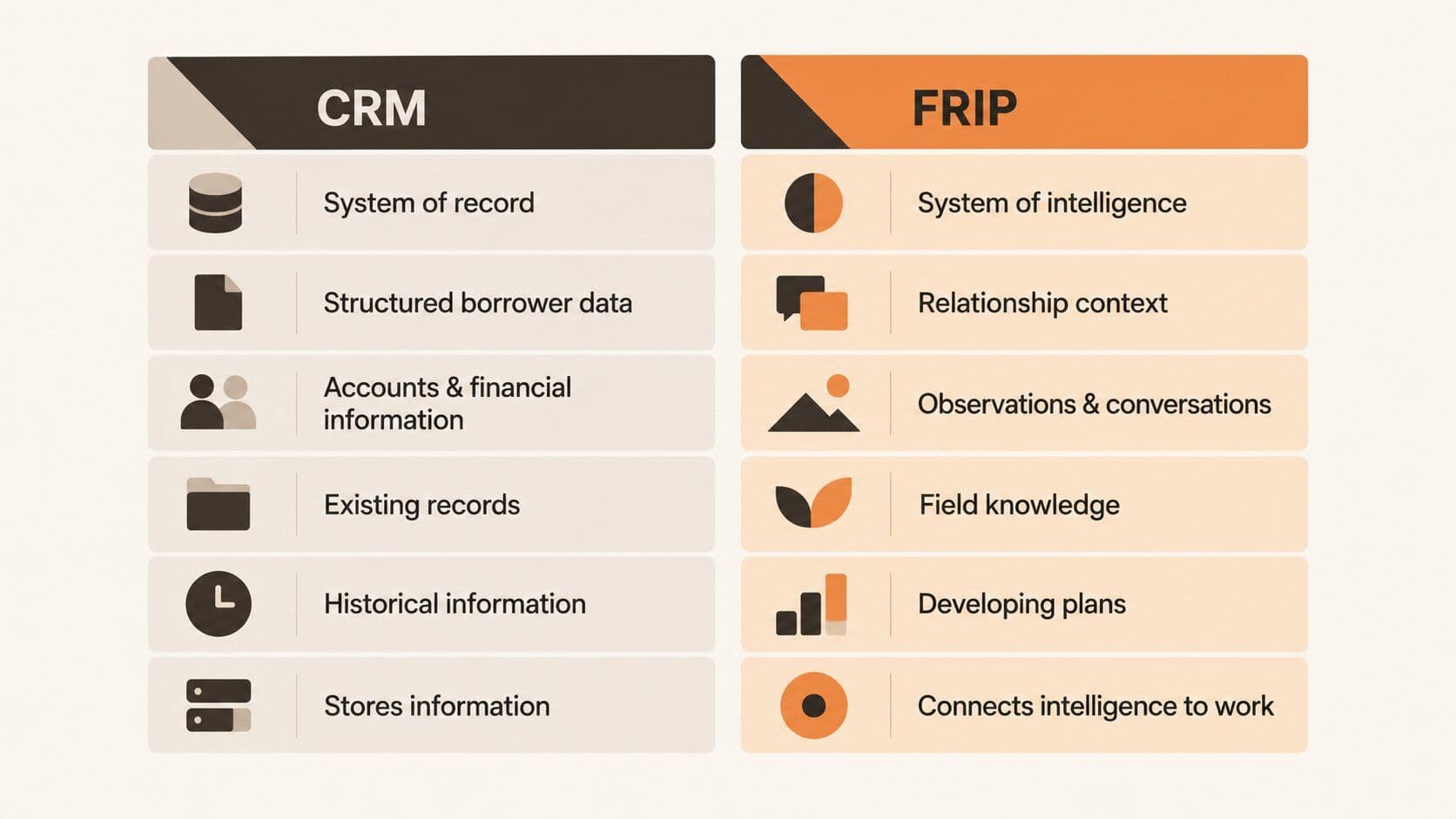
The distinction is straightforward:
The CRM records what was entered. FRIP helps preserve what the relationship manager understood.
For Farm Credit relationship management, the two layers have different jobs. Structured systems continue doing what they do well. FRIP gives qualitative field intelligence a way to become useful alongside them.
Every Visit Leaves Something Behind
A farm visit does not always end with a new financing request. Sometimes its value is subtler: a plan has become more concrete. A timing assumption has changed. A concern deserves another conversation. A commitment needs to resurface at the right moment.
Relationship managers already create that intelligence through the work they do every day. FRIP gives it a path from the field into the borrower relationship and from the borrower relationship into what happens next.
The opportunity is not to put more data into the CRM. It is to make more of what the relationship manager actually learned available when it can be useful.
What would change if the intelligence created in every borrower conversation could help shape the next one?
Frequently asked questions
What does FRIP stand for?
FRIP stands for Farm Relationship Intelligence Platform. It captures what relationship managers learn through borrower interactions, connects that intelligence with the relevant borrower, and makes it useful for future preparation and follow-through.
How is FRIP different from meeting summary tools?
Meeting summary tools primarily capture or summarize what was said. FRIP is designed to capture what the relationship manager learned, connect that intelligence with the borrower's relationship, and make relevant context available for subsequent work.
Does FRIP replace the CRM?
No. The CRM remains in the system of record for structured borrower and account information. FRIP works alongside it as a relationship-intelligence layer for field knowledge and qualitative context.
Does FRIP decide what matters instead of the relationship manager?
No. The relationship manager provides the interpretation of what mattered during the borrower interaction. FRIP structures and connects that intelligence. Auron can also be configured, so workflows pause for human approval before an action proceeds.
Can FRIP ask follow-up questions during a debrief?
Auron supports a Discovery mode in which the agent actively asks follow-up questions to draw out additional details. Whether that mode is used in a specific FRIP workflow depends on how the agent is configured.
What happens to field intelligence after it is captured?
It can be associated with the relevant borrower's record and contribute to the context available for later conversations, preparation, and configured follow-through. Auron’s records are designed to anchor sessions and accumulate knowledge around the relevant account.
How does FRIP handle data security, governance, and human oversight?
Auron uses organization-level boundaries and supports defined roles, teams, and record-level access. Record access also governs access to associated sessions, signals, summaries, and reports. Configured workflows can include human approval before actions proceed. The specific governance and deployment approach can then be aligned with the Farm Credit organization’s requirements.